


I kept rewriting everything the AI wrote.
The content was technically correct but generic. Corporate tone that didn’t match our style. Examples that could have been for any product. Missing the context that makes ours different.
The AI wasn’t the problem. I was asking it to write documentation without giving it the information it needed.
What changed
We now keep a context file next to the codebase. Every time I prompt an AI agent, I feed this file in first.
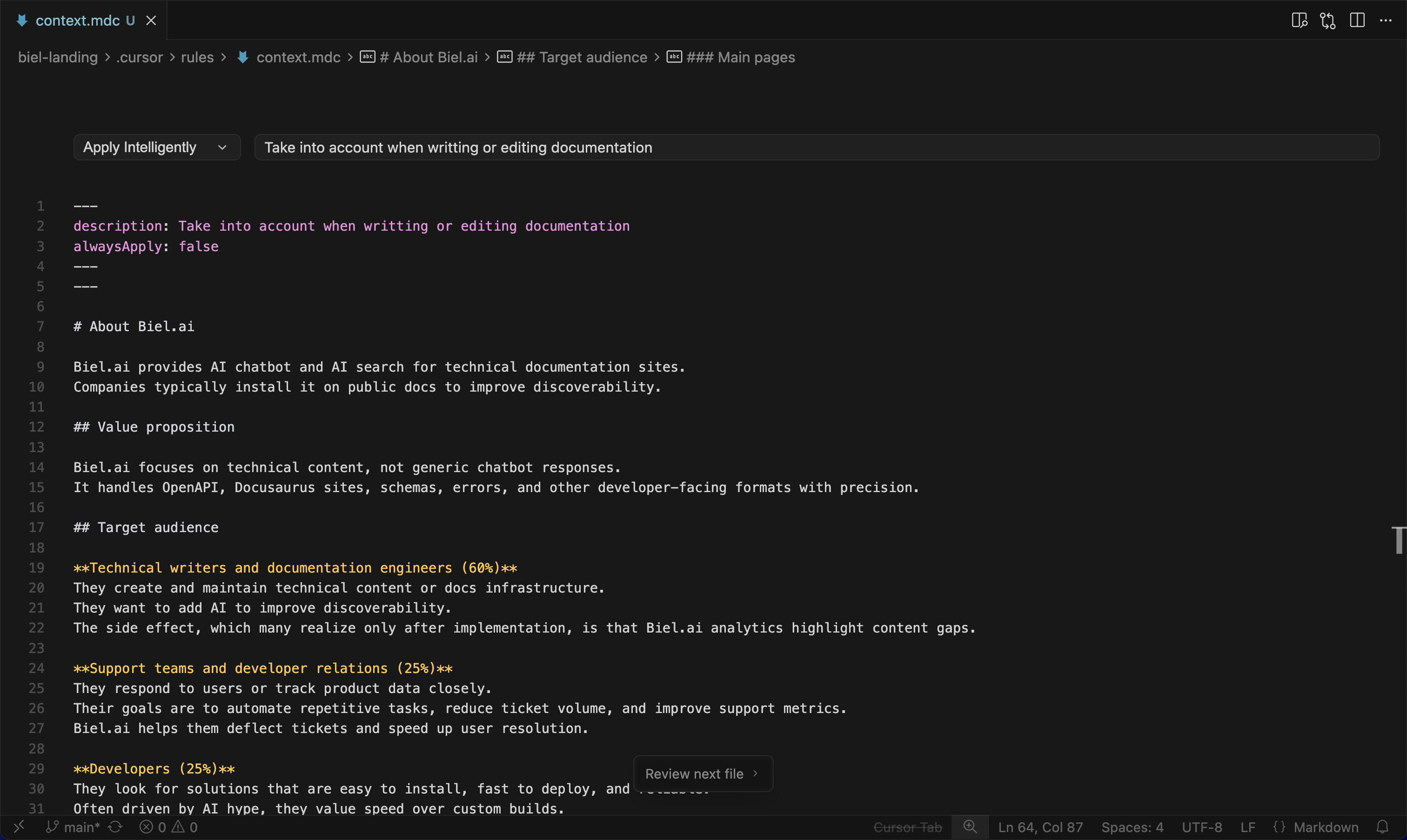
Without context file:
“Welcome to Biel.ai! We’re excited to help you get started with our amazing AI chatbot platform.”
With context file:
“Biel.ai trains on your documentation to answer technical questions. This guide gets you from zero to a working chatbot in 10 minutes.”
The second version matches our voice, uses our positioning, and focuses on the user.
Think of it like onboarding a new team member. You don’t say “go write docs” and expect great results. You explain the product, the users, the style, the constraints. Same with AI.
How to build one
Create a markdown file next to your codebase and include:
1. Three sentences about your product
2. Who uses it and why (specific personas, not “developers”)
3. How you write, what to avoid, examples of good vs. bad. Paste 3-5 examples from your best docs (this is your voice)
4. Common use cases (actual workflows)
5. Technical details (stack, repo structure, naming conventions)
Commit it so it versions with your code, and update it whenever you catch the AI producing results that miss the mark.
Use it for docs, marketing copy, support responses, tutorials, release notes. Anywhere AI writes for your product.
More advanced: If your IDE supports rules (like Cursor’s .cursor/rules), add the context file there and it’ll feed into every prompt automatically.
An unexpected benefit
The context file started aligning the whole team. New engineers read it to understand positioning. Writers use it for consistency. Product managers reference it when describing features. It became our single source of truth for how we talk about the product.
Worth the 30 minutes to set up.