


At Biel.ai, we have a new AI teammate called Nova. One of its jobs is keeping the documentation up to date.
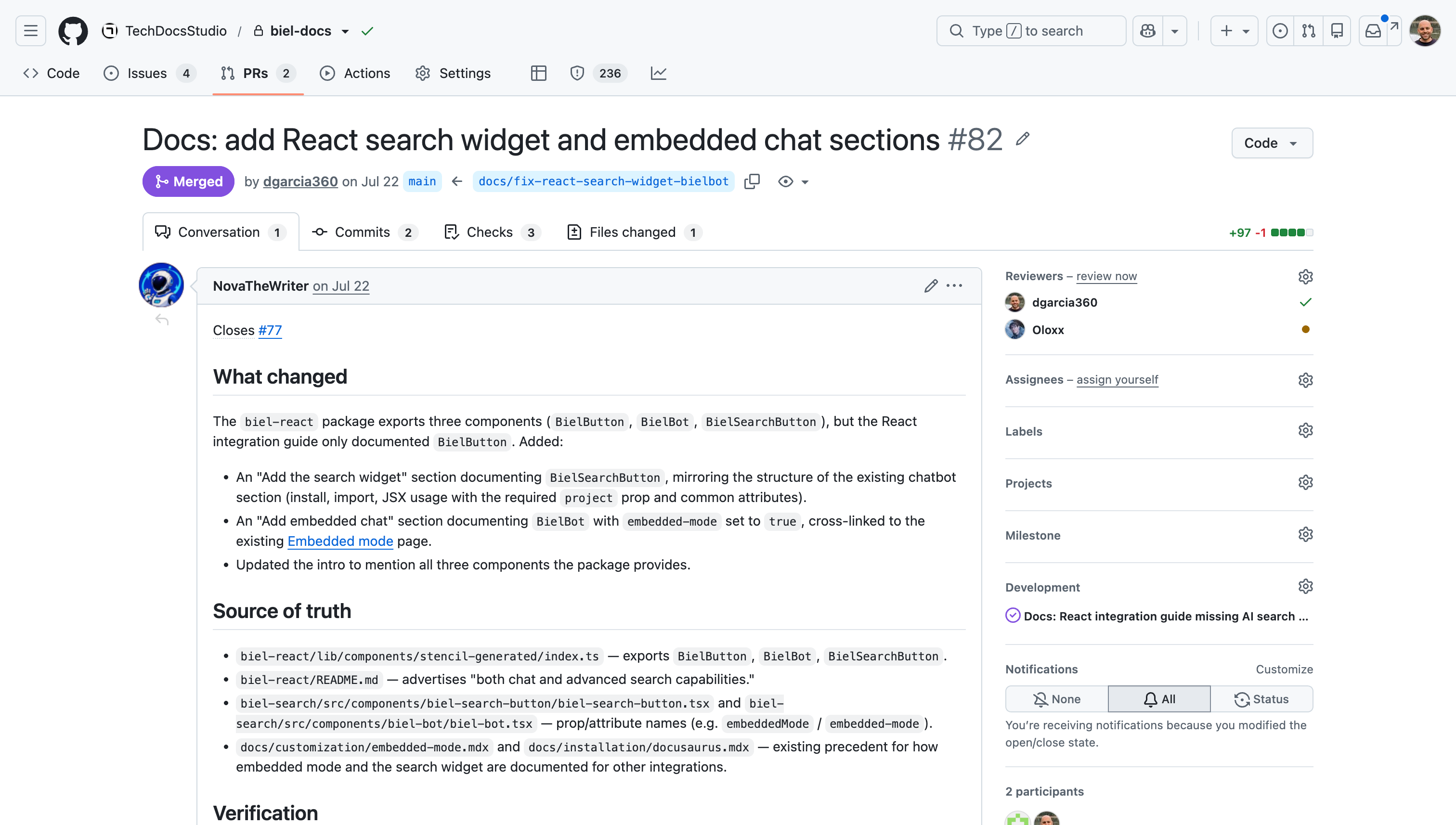
In one PR, it picked up a gap in our React integration guide. The package provided three components, but the instructions only covered one.
Nova added the missing search-widget and embedded-chat sections, including installation steps and code examples. It also updated the introduction and linked to our existing embedded-mode documentation.
We reviewed the update in the PR and merged it:
This is how the workflow runs. Nova checks merged pull requests and recent commits on main, reads the changes, and compares them with our docs. When it finds documentation work, it opens a follow-up PR.
That might be an undocumented property, instructions that no longer work, or a missing guide. Its updates can include screenshots too.
We review and iterate in the PR. We correct the draft, ask for changes, and keep working there until it is ready.
For a technical writer, there is a lot of work before that first draft: inspecting product changes, finding affected pages, and establishing what readers now need to know. Nova handles that recurring investigation and brings a proposed update into our review process.
Checking beyond recent changes
Nova also reviews the codebase against the documentation once a week, independently of the recent-change checks.
That lets it look for gaps that were already there. Waiting for a new commit would leave some of those untouched.
It keeps a record of which areas it has reviewed and works through the product over successive runs. We need that record so the weekly review covers new ground.
Findings arrive as PRs, just like updates from the commit checks. Nova can finish a run without opening anything if it finds no documentation work.
What we are still correcting
Nova follows our style guide and the writing instructions we have refined through review. We still make corrections.
The important instructions cover what to document, what to leave out, and which type of page the reader needs.
Access to the codebase gives Nova plenty of material that does not belong in public docs. We have to define those boundaries.
We also need it to distinguish a reference update from a guide. Getting the technical facts right does not help much if we have to restructure the whole draft during review.
We refine those instructions as we work through the PRs. The drafts give us concrete examples of where our guidance is useful and where it needs to be clearer.
Having Nova handle recurring checks creates room for work I want to spend more time on: improving difficult guides, deciding which workflows need better explanations, and keeping the docs easy to navigate as the product grows.
Have you tried automating documentation maintenance? Reply and tell me what worked. But especially what didn’t!